
Pillion – love, power and desire on the passenger seat
In this article
“Pillion – love, power and desire on the passenger seat” was written for BDSMforyou.nl by Mistress Moriah.
Sometimes a film comes along that doesn't use BDSM as sensation or a stylistic device, but as a lens to explore something essential: how people relate to one another, where surrender begins and where identity becomes visible.
The British feature film Pillion (2026), the feature debut of director Harry Lighton, positions itself precisely in that field of tension between love, power, humour and alienation.
The film is released in Dutch cinemas on 26 March 2026, has a running time of 105 minutes and is presented internationally as a drama from Great Britain.
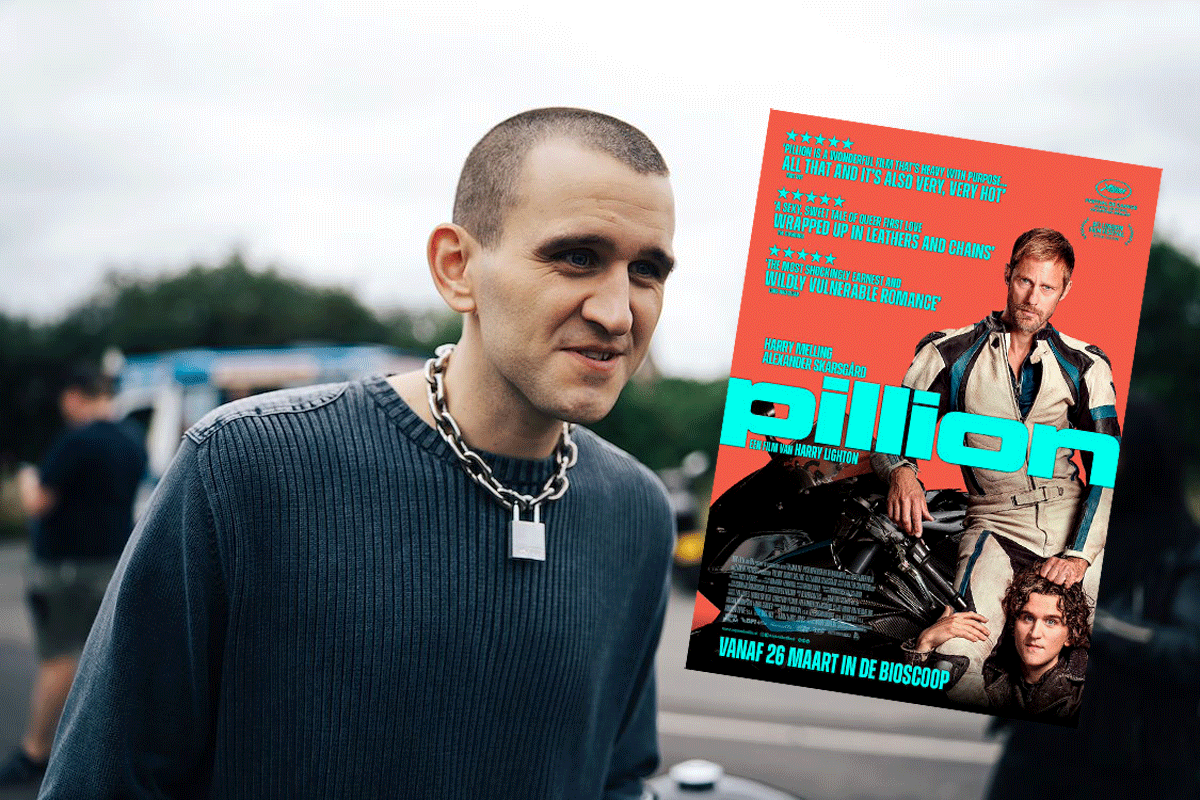
What is Pillion about?
At the centre is Colin, a shy traffic warden who leads a colourless existence and longs for connection. His life changes when he meets Ray, a charismatic motorcycle club leader who dresses entirely in leather and represents a world Colin has never entered before.
What begins as an overwhelming attraction grows into a relationship in which clear Dominant-submissive dynamics emerge. Colin surrenders to Ray and discovers a new reality of desire and devotion, but gradually has to determine where his own limits lie.
The title says it all. “Pillion” literally means the passenger seat at the back of a motorcycle, but within gay motorcycle culture the word also carries a clear submissive charge: the one who rides along trusts completely in the one who steers.
Not a sensation film, but a relationship story
Although the film has an explicit BDSM context, director Lighton regards the work first and foremost as a love story and a study of the power dynamics that exist in every relationship.
The film explores how:
power and care can exist side by side
inequality is sometimes chosen deliberately
people redefine their desires within a relationship
society's assumptions about “healthy” relationships are not always right
The makers wanted to show that such dynamics are not by definition deviant or destructive, but can be part of human connection.
The clash between two worlds
Colin and Ray are emphatically each other's opposites. Colin lives passively, insecurely and in the background of his own life, while Ray is a man who functions entirely outside social conventions and shapes his existence according to his own desire.
That asymmetry is the engine of the story. Ray acts as a guide in an unfamiliar world, while Colin discovers that his capacity for devotion is greater than he ever thought.
But the film also asks the question: is complete surrender a liberation, or merely another form of dependence?
Based on a literary source
The screenplay is based on the novel Box Hill by writer Adam Mars-Jones, but Lighton took great liberties in the adaptation to bring the relationship and the subculture to life on screen.
In early versions the story even took place in completely different locations, but in the end the director returned to the world of queer motorcyclists because that was where the relational dynamic came across most strongly.
Authenticity over cliché
For the film, the production worked closely with a real gay motorcycle club, whose members also appear in the film.
That research taught the makers that such clubs are far less about sex than is often assumed and function mainly as community, camaraderie and identity.
The film therefore deliberately tries to distance itself from the stereotypical image of biker culture as violent or hypermasculine, and instead shows everyday life alongside intimacy.
Intimacy as a carefully told element
Because the film contains explicit relational and physical scenes, an intimacy coordinator was involved from the preparation stage to shape every scene carefully, both in content and in practice. The intention was that intimacy remained functional to the story and never became detached from character development.
A film about contrasts
The makers describe Pillion as a combination of:
humour and discomfort
tenderness and brutality
romance and alienation
These contrasts are deliberate. The story wants to show that relationships are not one-dimensional and that love sometimes develops precisely in forms that fall outside the familiar framework.
Cast and production
The leading roles are played by:
Alexander Skarsgård as Ray
Harry Melling as Colin
The film was produced by Element Pictures and is Lighton's first feature film after a series of award-winning short films.
Why this film stands out in the world of BDSM films
Where many films use BDSM as provocation or aesthetic backdrop, Pillion tries to normalise the subject without oversimplifying it. The story is not about spectacle, but about:
how power works between people
how desire can shape identity
how relationships are always negotiations, even outside BDSM
Or as Lighton himself sums it up: he wanted to show the “contradictions of unconventional relationships”, in which harshness and tenderness exist at the same time.
Pillion is therefore not a kinky curiosity, but a character-driven arthouse film that uses BDSM as a means to say something universal about love, dependence and self-becoming.
Mistress Moriah
Source
Text: Mistress Moriah
Photography: September Film
Dit artikel is ook beschikbaar in het Nederlands →
Read also

Top 20 Film Recommendations About BDSM
The 20 best BDSM films in a row, personally chosen by Mistress Moriah. Films full of power, surrender and tension for a kinky film night.
4 May 2025
Art: Is there such a thing as BDSM-inspired art?
Is there such a thing as BDSM-inspired art? Perhaps it's my rose-tinted glasses, but I find BDSM absolutely captivating
30 April 2025
The Influence of Literature and Pop Culture on BDSM
What is the influence of literature and pop culture on BDSM? Or does it have no influence at all on the size of the BDSM scene? Practising BDSM is
10 October 2024