
Waterboarding and BDSM
In this article
“Waterboarding and BDSM” was written for BDSMforyou.nl by Mistress Moriah.
Waterboarding is perhaps not the first thing you think of when it comes to breath play; you are more likely to think of extreme torture techniques. Yet it does also occur within BDSM, so it may be useful to give it some attention. Before you start getting involved in this, it is wise to read up on it thoroughly first. It can be a powerful, confronting experience, but also a dangerous one. That is why it is important to know what you are doing, what the risks are and how to carry it out as safely as possible.

What is waterboarding?
Waterboarding is a form of controlled suffocation in which water is poured over the sub's face while their breathing is restricted. In waterboarding as torture, the sub lies on their back with the head slightly lower than the rest of the body. Within BDSM, it is better to waterboard the sub in a half-seated position, so that the water can run off more easily. A cloth or towel is placed over the nose and mouth, after which water is slowly poured over it. This leaves the sub barely able to breathe and creates the sensation of drowning.
That feeling - the panic, the loss of control, the intense surrender - can be a deeply emotional or erotic experience for some submissives. But let there be no misunderstanding: this is not a beginners' game. Waterboarding is extremely demanding physically and mentally and only belongs with very experienced players who know each other's limits, signals and safety needs in detail. Know what you are getting into, because it can be experienced as enormously intense. So make good agreements beforehand about safewords or stop signals, so that the experience can be stopped immediately.
How does it work?
In a BDSM context, waterboarding is usually carried out with:
a sturdy towel or cotton cloth over the face
a bowl or watering can with lukewarm water (not cold water!)
and a well-prepared Dominant who observes constantly
The Dominant slowly pours water over the cloth, giving the sub the illusion of drowning. The airways remain partly open, but breathing is severely restricted. It is an intense form of breath control, and that means there are always risks involved.
Some players opt for milder variations, for example using a wet flannel or briefly submerging the face in a bowl of water. Either way: this play demands utmost control, calm and knowledge of what the body can handle.
The risks
Waterboarding is one of the most dangerous forms of breath control within BDSM. The risks are considerable:
Suffocation or fainting: breathing can stop faster than you expect.
Water in the lungs: even small amounts can cause pneumonia.
“Secondary drowning”: fluid in the lungs can still lead to breathing problems or even suffocation hours later.
Panic attacks or trauma: the feeling of drowning can bring up old fears or traumas in some people.
Loss of consciousness: oxygen deprivation can occur suddenly.
That is why, more than ever, the rule applies: only do this if you know exactly what you are doing, and only with someone you trust completely.
How do you do it as safely as possible?
Although there is no way to make waterboarding completely safe, there are steps that can reduce the risk:
Use a safe setting. Make sure the sub lies upright or half-seated, so that water can run off easily. In the classic torture position the head is actually slightly lower than the chest to intensify the drowning sensation, but that also increases the risk of suffocation and water in the lungs. So choose a flat or slightly raised position instead, so that you keep better control.
Use lukewarm water. Cold water can disrupt breathing even faster.
Do not use cling film or masks. They can block breathing completely.
Work in short intervals. Pour water for only a few seconds at a time and give the sub time to breathe in between.
Make clear agreements. Agree beforehand on a stop signal that also works when the sub can no longer use words - for example dropping a small ball or tapping with the hand.
Observe continuously. Watch for panic, change of colour, cramping or stiffening. As soon as you feel doubt: stop.
Never leave the sub alone. Not even afterwards.
The position: know how to let the sub lie
When someone lies on their back, water poured over them flows towards the nose and mouth. If the head is too low, the water stays on the nose and mouth for longer → this obstructs breathing more, but also increases the chance of really choking or getting water in the lungs. If the head is too high (chin on chest), the airway actually kinks shut → that also makes breathing harder.
Applied to BDSM:
The safest compromise position is therefore half-seated or leaning slightly backwards, with the face able to turn a little to the side. That way water runs off by itself, while the sense of losing control is still present, but with much less chance of suffocation or aspiration (water in the lungs).
Do not do this
Lying completely flat on the back with the head down is medically the most dangerous. The water then stays in the throat and nasal cavity and can draw small amounts into the lungs with every breath (the cause of secondary drowning).
In short:
Head slightly lower than the chest: more realistic drowning sensation, but high risk.
Head neutral or slightly tilted back, half-seated: much safer, better airway, water runs off more easily.
Risks afterwards – secondary drowning
What many people don't know is that the danger of waterboarding is not always over immediately. There is something called secondary drowning. A small amount of water ends up in the lungs during play. That water later causes irritation, making the lungs swell. Breathing then slowly becomes more difficult, sometimes only hours after the play.
The symptoms can start subtly: coughing, fatigue, shortness of breath, pain when breathing. If this occurs within 24 hours of the session, it is important to call for medical help immediately.
When it is better not to do it
Waterboarding is absolutely not advisable for people with:
asthma or lung problems,
heart problems or high blood pressure,
panic disorders or fear of suffocation,
previous drowning experiences or traumas.
And even for healthy people this holds true: this play is rarely without risk. The line between “intense” and “dangerous” is thin, and a Dominant who truly takes responsibility knows when something goes too far.
It is not a game
Waterboarding within BDSM is not a game, but an extreme form of surrender and control that must be approached with the greatest respect and knowledge. The essence of BDSM lies in awareness, safety and trust - not in seeking out medical danger. Anyone who experiments with breath control does so not to prove how far they dare to go, but to experience something intimate together within clear limits.
Use your common sense, communicate, and remember: the goal is never to literally take someone's breath away, but to create an experience in which control and surrender meet - without anyone being physically or mentally overwhelmed by it.
Mistress Moriah
Source
Text: Mistress Moriah
Illustration: 123rf.com
Dit artikel is ook beschikbaar in het Nederlands →
Read also

The thrill and appeal of choking
Discover what choking is, the experience behind it, the risks and how to do it as safely as possible. An informative blog about this intense form of…
21 June 2025
The Power of Powerlessness
The Power of Powerlessness.“ The foundation of BDSM lies in the balance between power and powerlessness. That powerlessness can be experienced in all…
8 April 2026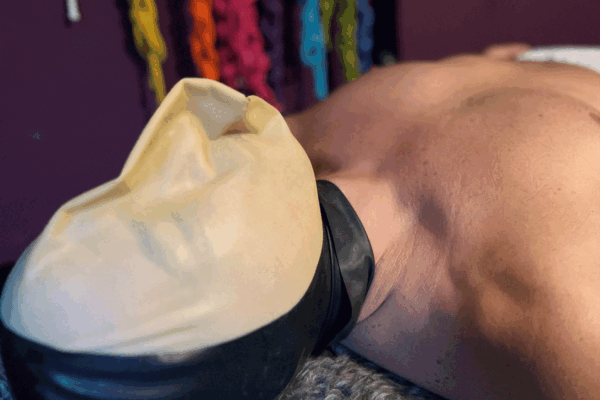
Hypoxophilia, breath holding, or breath control
Hypoxophilia, breath holding, or breath control. Breath control is not a harmless game. It is also known by the names hypoxiphilia, breath reduction…
20 April 2026