
Mary Magdalene – a forgotten queen of strength
In this article
"Mary Magdalene – a forgotten queen of strength" was written for BDSMforyou.nl by Mistress Moriah.
Sometimes you carry a knowing with you without knowing where it comes from. Raised Roman Catholic as a child, I already felt it: this woman, Mary Magdalene, was not what I was being told. I saw the images, heard the words, but somewhere something didn't add up. The Mary Magdalene who was presented there as a penitent sinner, reduced to a lesson in humility, felt like a flattened version of a woman who must once have lived in full colour. What I felt whenever her name was mentioned was strength. Not submissiveness. That feeling has never gone away.
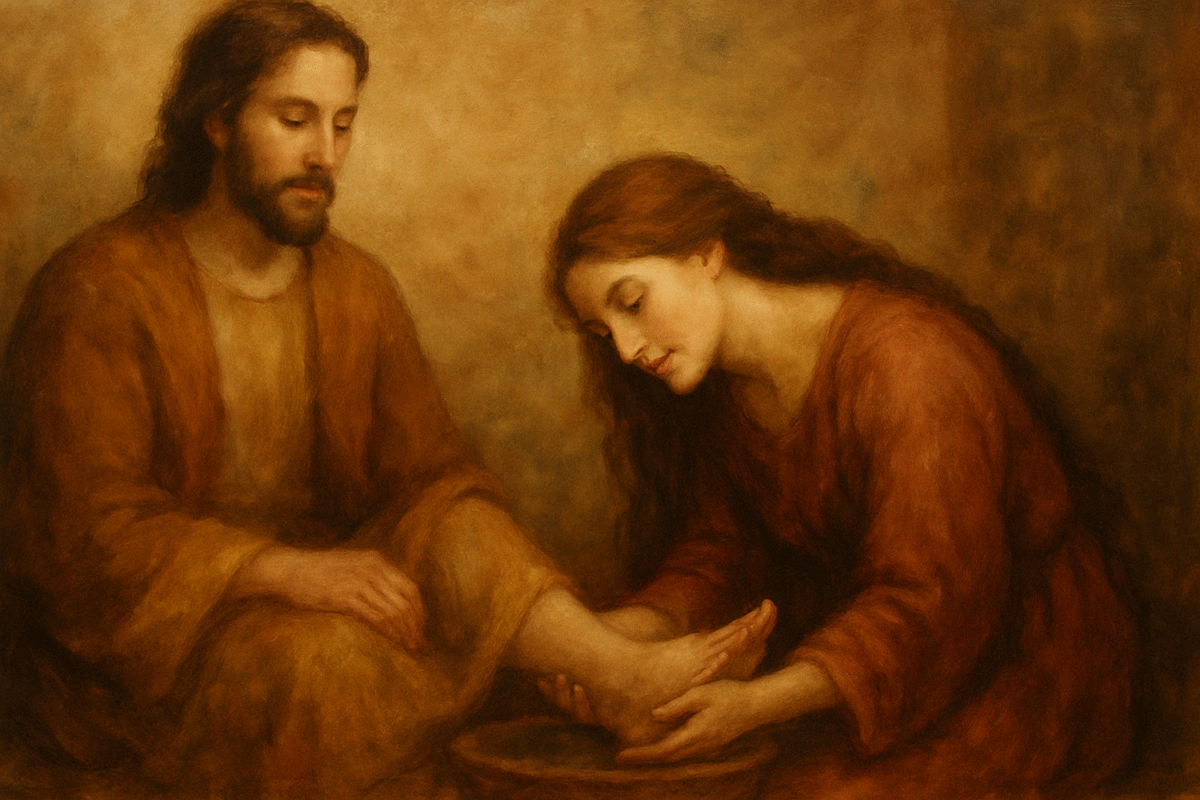
Later I discovered that 22 July is her name day. Coincidentally also my birthday. That kind of detail doesn't have to mean anything mystical, but it can feel like a gentle confirmation that some lines in life don't run straight, but form circles. This story is not about identification or grand claims. I am not her. But her story resonates. As it does with many women, often without them being able to explain exactly why.
A woman in the shadow of men
Mary Magdalene appears in the gospels strikingly emphatically. She is present at the crucifixion while many others have fled. She stays present where it becomes painful. She goes to the tomb. And according to the Gospel of John, she is the first to meet the risen Jesus. Not one of the male apostles, but her. That fact alone says something about her position within that circle. She was not an extra. She was a confidante. A witness. Someone who stayed standing.
And yet her image shifted over the centuries that followed. In 591, Pope Gregory I declared her to be the sinful woman from the Gospel of Luke. An interpretation, not a factual description, but one that has had enormous influence. From that moment on, Mary Magdalene was seen in the Western tradition mainly as the fallen woman who shows repentance. Her spiritual authority gave way to moralistic symbolism. Her presence was rewritten into a warning.
The weakening of her being
It is fascinating how often history has reduced strong women to something safer and easier to digest. As if strength can only be accepted once it has first been broken. A woman who loves, acts, understands and keeps standing without submitting to the narrative of guilt is hard to fit into structures built around hierarchy and control. Perhaps that is precisely why her story was watered down.
In some early Christian texts that were later kept outside the official canon, such as the Gospel of Mary, a different picture appears. There she is described as the one who receives insights that the other disciples do not understand. Not as superior, but as someone with a different layer of perception. That actually makes her more human. She seems a woman who did not just follow, but saw through. Who was present with both head and heart.
The layers of her strength
What touches me in this is the combination of softness and strength. Not the caricature of dominance that revolves around power, but a form of leadership that comes from inner clarity. Knowing what you do, why you do it, and bearing the responsibility for it. That is a quality that is recognisable within a loving D/s dynamic. Not as a religious parallel, but as a human one. The willingness to stay present, even in vulnerability, even when it gets complicated.
Mary Magdalene was not a symbol of shame. She was a woman who was familiar with touch, with care, with the body, with loss and with loyalty. Those are not small qualities. Those are load-bearing forces. Qualities that are seen as essential in many spiritual traditions, but which historically have often been marginalised in women as soon as they came with autonomy.
An ode to all women
I therefore write this piece not as a historical analysis, but as an invitation to reappraisal. For anyone who ever felt that strength and softness weren't allowed to go together. For women who lead and sometimes feel uncomfortable with that because the image of leadership is still so often filled in as masculine. You don't have to make yourself smaller to be loving. You don't have to weaken yourself to be accepted. You don't have to choose between sensitivity and strength. Perhaps it is precisely the combination that allows you to be truly present.
Through all the distortions, Mary Magdalene still reminds us of this. Not as an icon of guilt, but as a silent witness to a different way of standing in the world. And perhaps that is precisely why her story continues to touch us. Because, despite everything that has changed about it, it still tells us something that wants to be recognised.
You don't have to make yourself smaller.
And you don't have to conform.
You only have to remember who you are.
As she did.
On 22 July.
And every day anew.
Mistress Moriah
Source
Text: Mistress Moriah
Photography: BDSMforyou.nl
Dit artikel is ook beschikbaar in het Nederlands →
Read also
Myths and Misconceptions about Femdom
Myths and Misconceptions about Femdom. When I'm somewhere and it "happens" to come up, I let people know (including outside the BDSM scene) that
29 December 2024
It's a mansworld and that will never change
It's a mansworld and that will never change. Sometimes I feel like a kind of Don Quixote tilting at windmills. For years now I have been using
9 January 2025
Mistresses Don't Cry: A Femdom Fairy Tale
Mistresses Don't Cry: A Femdom Fairy Tale. Once upon a time there was a Mistress: powerful, dominant, steadfast, balanced, sadistic, commanding and…
15 April 2025