
You long for surrender, but you're not submissive at all
In this article
- Submission is not the same as surrender
- Perhaps you’re not struggling with your desire, but with the label
- Surrender doesn’t even have to be directed toward a Dominant
- Trust and safety are the foundation
- You don’t always have to be strong to stay strong
- Perhaps the deepest surrender is the one to yourself
- You don’t have to call yourself a sub to be allowed to feel
Maybe there’s nothing contradictory about what you’re feeling at all. Maybe you’ve just always used the wrong words to understand your desire.
You’re a strong person. You know what you want, make your own decisions, and have absolutely no need to place anyone above yourself. The idea that you might be submissive doesn’t suit you. In fact, perhaps everything inside you resists that very thought. And yet, there’s that longing. To let go of control completely for once. To not have to constantly think things through, to not have to make any decisions, and to let yourself be completely swept away by an intense experience. Perhaps you’ve suppressed that desire for years because you couldn’t reconcile it with who you are. After all, how can you long for something so strongly associated with submission when you absolutely do not consider yourself submissive?
But what if those two aren’t inextricably linked at all? What if you don’t long for submission, but for something entirely different?
What if what you’re actually longing for is surrender?

Submission is not the same as surrender
In BDSM, we constantly talk about dominance and submission. One leads, the other follows. One takes control, the other relinquishes it. It’s a familiar power dynamic, but perhaps because of this, we’ve entangled two fundamentally different concepts too closely.
Submission has to do with your relationship to another person—with the desire to serve, to obey, or to consciously take on a subordinate position. Surrender is something else entirely. It is an inner experience in which you allow yourself to let go—to stop constantly trying to control, explain, or monitor everything—and to be fully present with what you’re feeling.
You don’t have to be submissive at all to do that.
You can be a powerful, independent woman who doesn’t need anyone to tell her what to do, and yet intensely enjoy a situation in which she temporarily doesn’t have to make any decisions. You can be a self-assured man who takes the lead and bears responsibility in daily life, but who longs to let himself be completely carried away by physical sensations, emotions, or the intensity of a BDSM experience.
That doesn’t automatically make you submissive. It makes you someone who longs for surrender.
Perhaps you’re not struggling with your desire, but with the label
How many people would reject their own desires because they can’t reconcile them with their self-image? Because they think that enjoying the release of control automatically means they’re submissive?
Maybe you can relate to that. You feel a certain attraction to BDSM, but as soon as the word submissive comes up, resistance arises. You don’t want to serve at all. You don’t want to obey. You don’t want to view yourself as inferior or subordinate. And so you conclude that BDSM probably isn’t for you after all.
But perhaps you’re not rejecting the experience itself. Perhaps you’re only rejecting the meaning you’ve assigned to it.
We’re so used to categorizing people within BDSM into roles that we sometimes forget to ask what someone truly desires. Not everyone who likes to let go of control wants to be a sub. Not everyone who allows themselves to be guided longs for a D/s relationship. And not everyone who surrenders completely does so to a Dominant.
Maybe you don’t need to redefine yourself at all. Maybe you can simply discover that there are more possibilities than the boxes we try to fit ourselves into.
Surrender doesn’t even have to be directed toward a Dominant
This might just be the most beautiful insight. Surrender doesn’t have to revolve around someone else at all.
You can surrender to the moment—to the touch of a hand, the rhythm of a flogger, the security of bondage, or the silence in which you hear nothing but your own breathing. To an emotion that surfaces unexpectedly. To an intense physical experience in which your thoughts slowly fade into the background.
At that moment, you don’t have to serve anyone. You don’t have to be obedient. You don’t even have to feel any need for a power dynamic. You’re simply allowed to experience.
A Dominant can play a wonderful role in this, but doesn’t have to be the goal of your surrender. They can also be the one who guides you, who creates the conditions in which you feel safe enough to let go. Who doesn’t diminish you, but instead gives you the space to be fully present. And sometimes that surrender arises even without a Dominant, during a solo experience in which you give yourself the freedom to feel everything that arises.
Trust and safety are the foundation
Surrender cannot be forced. You can order someone to kneel, assume a position, or carry out a command, but you cannot order anyone to truly open up on the inside. That requires something else: trust and a sense of safety.
Not just physical safety, but above all emotional safety. The assurance that you won’t be judged for what you feel. That your vulnerability won’t be used against you. That your boundaries will be respected and that you don’t have to prove anything.
Because surrender doesn’t mean you have to accept everything or forget your own boundaries. On the contrary. It’s precisely when you know that you can always stop, say no, or express what you need that space can open up to temporarily let go of that control.
And safety doesn’t mean everything has to be comfortable. A BDSM experience can be exciting, confrontational, intense, and sometimes emotionally complex. But there’s a big difference between excitement you consciously want to experience and a situation in which you genuinely feel unsafe.
The less you feel that you have to surrender, the more space there is to do so voluntarily.
Perhaps that is also one of the most important qualities of a good Dominant. Not the ability to force someone to surrender, but the ability to create an atmosphere in which surrender becomes possible.
You don’t always have to be strong to stay strong
We’ve often taught ourselves to stay on our feet at all times. We worry, make arrangements, make decisions, protect others, and shoulder responsibilities. We keep our emotions in check, guard our image, and prefer not to show where we’re vulnerable. But why would you lose strength when you temporarily let down that guard?
Why would a woman who fully surrenders to an intense experience be any less independent as a result? Why would a man who dares to show his emotions become any less powerful? Why would letting go of control diminish your self-worth?
Perhaps it actually takes courage to allow yourself to experience something that doesn’t fit the image you’ve had of yourself for years. You don’t always have to be the one who has everything under control. You’re also allowed to be the one who feels, receives, enjoys, cries, laughs, or lets yourself be completely swept away. Because that side of you has a right to exist, too.
Perhaps the deepest surrender is the one to yourself
And that brings us to something that reaches far beyond BDSM. What if true surrender doesn’t begin with letting go of control, but with letting go of your judgment of yourself? The moment you no longer try to explain why you have certain desires. The moment you stop forcing yourself into a role that doesn’t suit you. The moment you accept that you can be both powerful and vulnerable, both independent and receptive, both someone who likes to take the lead and someone who sometimes wants nothing more than to let yourself be carried away completely.
You don’t have to choose between those different sides of yourself. They can coexist without contradicting one another. Perhaps that’s why surrender can be so liberating—because you’re finally making room for parts of yourself that you’ve held back for a long time. And maybe you’ll discover that your desire isn’t nearly as complicated or contradictory as you’ve always thought.
You don’t have to call yourself a sub to be allowed to feel
Maybe it’s time we started asking different questions within BDSM. Not just whether someone is a Dominant, a submissive, or a switch, but what someone truly longs to experience. What would you like to surrender to? What would you like to let go of, if only for a moment? When do you feel safe enough to show your vulnerability? And which aspects of yourself haven’t you dared to give space to until now?
You don’t have to be submissive to long for surrender. You don’t have to obey to let yourself be guided. You don’t have to kneel to be deeply moved. And you don’t have to make yourself subordinate to temporarily let go of control.
Submissiveness can be a beautiful path to surrender, but it’s not the only one. And perhaps surrender is something entirely different for you than you’ve always thought. So if you’ve been struggling for years with a desire that doesn’t seem to fit who you are, try asking yourself a different question:
What do I truly long for when I don’t have to impose anything on myself for a moment?
Because maybe you don’t have to change yourself at all to understand your desires. Maybe you just need to stop holding yourself back.
Mistress Moriah
Dit artikel is ook beschikbaar in het Nederlands →
Read also
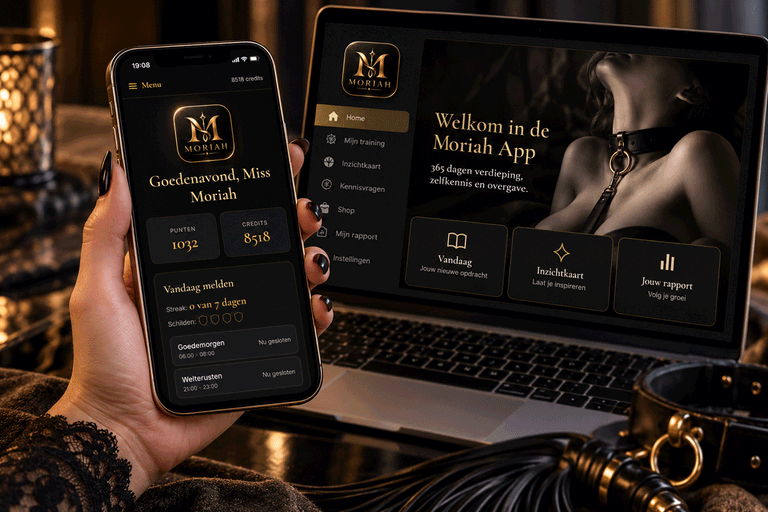
Why the Moriah App Is Especially Interesting for Couples: Growing Together in BDSM, 365 Days a Year
Samen groeien in BDSM? Ontdek de D/s Way van de Moriah App: 365 dagen opdrachten, kennis, inspiratie en verdieping voor koppels.
20 October 2026
Unique: Mistress Moriah's digital Slave Training
Slave Training. A year of daily coaching in submission. For single subs and couples. Discreet, with assignments, an exam, and a diploma.
17 October 2026
Fantasy versus Reality in BDSM
Fantasy versus Reality in BDSM. In the world of BDSM, I constantly come across this: the difference between what
13 October 2026