
Why do we fight each other when, in the end, we all want the same thing?
In this article
“Why do we fight each other when, in the end, we want the same thing?” was written for BDSMforyou.nl by Mistress Moriah.
Sometimes I genuinely wonder why it seems so difficult within the BDSM scene to be generous toward one another, to support one another, and—above all—to focus on what connects us.
That question doesn’t stem from a single incident. It’s something I’ve come across repeatedly over the years, and as I invest more and more time and energy in the BDSM world, it actually surprises me more and more. Perhaps it even saddens me.
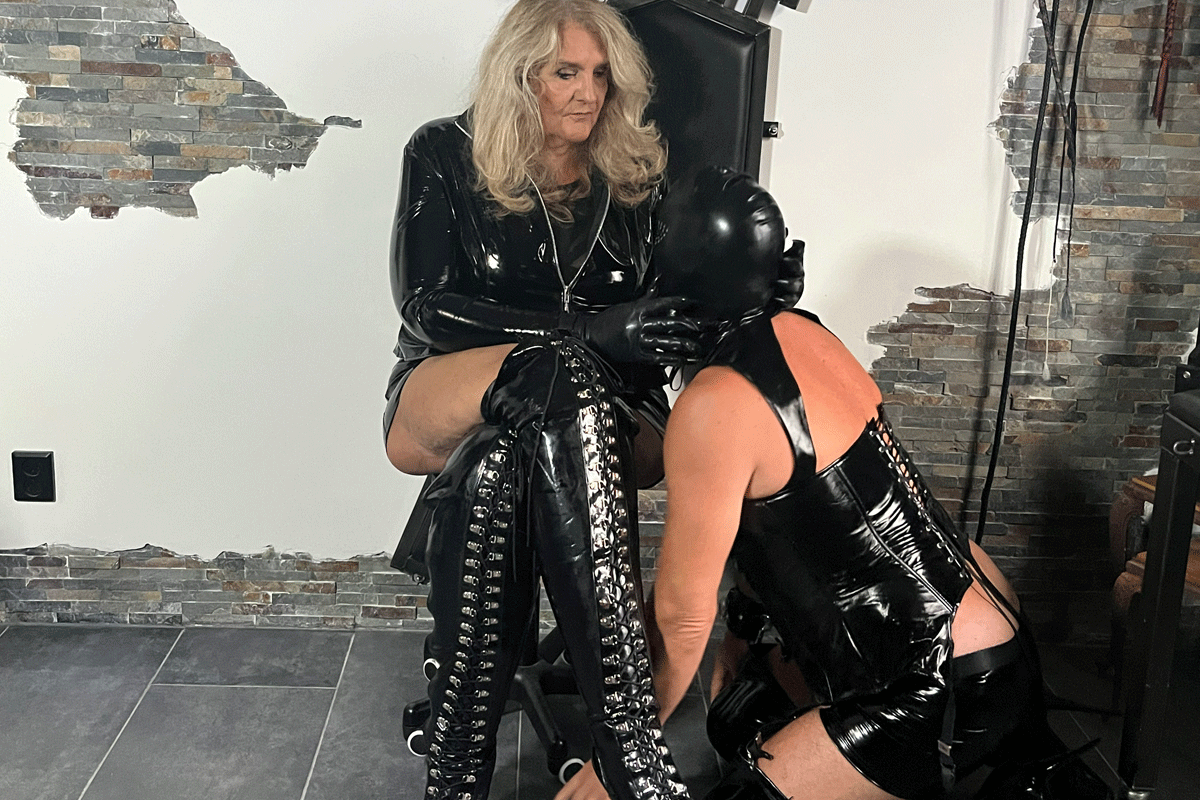
A Big Mission
I’ve set myself a pretty big mission. I want to bring BDSM out of the shadows. I want to show that BDSM is so much more than the images the outside world often has of it—that it can be intense, beautiful, loving, connecting, exciting, vulnerable, and sometimes life-changing. That there’s a whole world behind it where people can discover parts of themselves that they may have hidden away for years.
At the same time, I want to contribute to raising awareness. Because no matter how beautiful BDSM can be, it requires responsibility. Knowing what you’re doing. Understanding what certain acts can do to someone physically and mentally. Learning about boundaries, communication, safety, consent, and aftercare. Not to make BDSM clinical or to eliminate every risk—because that’s simply impossible - but to give people the information they need to make more informed choices.
That’s now almost a full-time job in itself.
I spend my days writing
I write for my websites, contribute to the BDSM Encyclopedia, create podcasts, write books, share information on social media, and develop an online learning environment within the Pro Domme Society where knowledge and experience can be further shared. I write articles, research topics, read studies, answer questions, and try to explain complex subjects in a way that’s actually helpful to people.
For a large part of that work, I don’t get paid at all. Much of the information I create is simply freely available online. I’m not saying this because I expect applause for it. I chose to do this myself. I do it because BDSM is my passion and because I believe that good information can contribute to a safer scene and to a more realistic view of BDSM outside that scene. The fact that I encounter resistance from the outside world doesn’t really surprise me.
BDSM simply evokes prejudices. People who know little about it sometimes think it’s exclusively about pain, sex, abuse, or strange people in dark basements. There’s still a world of work to be done there. That’s precisely why I write so much. That’s precisely why I talk about it. And that’s exactly why I try to make BDSM a topic of discussion outside our own bubble. But I find resistance from within the BDSM scene itself much harder to understand.
Why would we fight each other?
Why would people who, at the end of the day, want largely the same things, get in each other’s way, ignore each other, or view each other as competitors?
Of course, we don’t all have to agree with one another. In fact, I wouldn’t want that at all. BDSM is far too diverse to have a single truth. What I find to be a wonderful dynamic might do absolutely nothing for someone else. Where I make certain safety choices, someone else might weigh the options differently.
Where one person needs protocols and structure, another finds that spontaneously irritating. We even have a wonderful expression for that within BDSM: YKINMK – Your Kink Is Not My Kink. So why don’t we apply that principle a little more often to our ideas, initiatives, and organizations?
We’re allowed to think differently. We’re allowed to be critical of one another. We’re even allowed to challenge each other’s views, because we can all benefit from that. But when the underlying goal is the same, why should difference automatically mean competition?
If you want to make BDSM safer, more visible, better understood, or more professional—and I want that too—then I see, first and foremost, someone with whom I have something in common. Maybe we can exchange knowledge. Maybe we can refer people to each other. Maybe we can organize something together. Maybe we each reach a completely different audience, and that’s precisely why we can be of value to one another. And maybe, after just one conversation, we’ll realize that working together just isn’t going to work. That’s fine, too. But at least we’ll have met each other.
Women Among Themselves
Perhaps this resonates with me the most when it comes to women. One of the reasons I started the Pro Domme Society is my belief that women could empower each other much more. Not by all becoming the same or constantly agreeing with one another, but precisely by sharing knowledge, experience, and opportunities.
If another woman accomplishes something wonderful, doesn’t that make what I do any less significant? If she’s incredibly good at something, doesn’t that mean I don’t have to be any worse off because of it? And if I’ve built something that could be useful to her, why should I cling to it so tightly for myself? That’s why I regularly reach out to others when I see opportunities for collaboration. Just out of curiosity: can we help each other?
What never ceases to amaze me is how often I get no response at all. No “no,” no “thank you, but this isn’t for me,” not even a short message. Just nothing. And to be honest, I really don’t understand that.
Maybe I’m naive in that regard. Maybe I view competition differently. I believe, after all, that your own strength isn’t diminished when you give others space. On the contrary. When different people and organizations within the BDSM community reinforce one another, I believe something emerges that’s much harder to achieve individually. Especially if we want to reach out to the outside world.
How do we want the outside world to view us?
We want to be taken seriously. We want people to understand that BDSM doesn’t automatically mean abuse. We want consensual BDSM not to be confused with violence. We want space for our sexuality, our relationships, our dynamics, and our way of life. But how strong a stance do we take toward the outside world when, in the meantime, within our own little world, we’re mostly busy fighting each other? I honestly find that a sad sight at times.
Not because criticism should be forbidden. On the contrary. A healthy community must be able to withstand criticism. Misconduct must be called out, and no one should be spared just because they happen to belong to the same scene. But there’s a difference between being critical and refusing to let each other shine. And perhaps that’s where my real question lies.
What are we afraid of losing when we help someone else within our scene grow?
Attention? Status? Visitors? Customers? Recognition? The feeling that we were the ones who came up with something first? And is what we think we’re protecting really greater than what we could build together?
I don’t know the answer. Maybe there are good reasons why others see this very differently than I do. That’s why I’m not writing this to lecture anyone. On the contrary, I’d really like to understand where that reluctance comes from. Because my first instinct will always be collaboration.
Not with everyone, and not at any cost. To me, connection doesn’t mean having no boundaries or having to accept everything. Sometimes people just aren’t a good fit. Sometimes their core beliefs differ too much. Sometimes trust is missing. Then it ends there. But I’d like to be able to see someone as a potential ally—to at least keep that option open, initially.
We don’t have to share each other’s kinks. We don’t have to fully endorse each other’s views. We don’t even all have to become friends. But if, ultimately, we share the same greater desire—a BDSM world where people are free to discover themselves, where knowledge is accessible, where we learn from one another, and where the outside world finally looks beyond the caricatured image of whips, leather, and dark basements—then I’d much rather explore where we can find common ground. Because I believe that no one in our scene becomes stronger when we try to make each other feel smaller.
So I’d like to pose this open-ended question: Why is collaboration within the BDSM scene sometimes so difficult? And what could we achieve if we focused a little less on who’s standing next to us, and a little more on the direction we’re trying to move in together?
Mistress Moriah
Source
Text & picture: Mistress Moriah
Dit artikel is ook beschikbaar in het Nederlands →
Read also

The erosion and destruction of BDSM
The erosion and destruction of BDSM. But fortunately, we alone are responsible for letting the sun shine in our lives… For me, BDSM—and Femdom in…
11 May 2026
Why the Moriah App Is Especially Interesting for Couples: Growing Together in BDSM, 365 Days a Year
Samen groeien in BDSM? Ontdek de D/s Way van de Moriah App: 365 dagen opdrachten, kennis, inspiratie en verdieping voor koppels.
20 October 2026
Why are there so many BDSM safety models?
Why are there so many BDSM safety models? Anyone who delves into BDSM will sooner or later come across a whole range of terms that all seem to say…
14 September 2026