
How to spot bad Doms? Red flags for subs (and vice versa)
In this article
- BDSM requires more than nerve and desire
- Why recognising red flags is so important
- Here is a clear overview: good leadership versus harmful behaviour
- How bad Doms often show themselves
- But also: bad subs exist
- Signals you should take seriously
- How do you reduce the chance of a wrong dynamic?
- Ultimately, it all comes down to reciprocity
- Want to read more about safe BDSM experiences? Also take a look at:
- Frequently asked questions
- Source
“How to spot bad Doms? Red flags for subs (and vice versa)“ was written for BDSMforyou.nl by Mistress Moriah.
Definition of a bad Dom
A bad Dom is someone who abuses the power dynamic within BDSM. That can mean ignoring limits, interpreting consent selectively, or causing emotional, physical or mental harm without care, aftercare or responsibility. Power then stops being a role that is carried with care and becomes a free pass to satisfy your own needs.
A short disclaimer first
For readability, this text is written using "he". That explicitly does not mean that bad Doms are only men. Dominant women can also cross boundaries. Wherever you read "he", you can just as easily read "she".

BDSM requires more than nerve and desire
BDSM is about trust. About surrender, which can only happen when there is safety. Power within BDSM is never separate from responsibility. And that is exactly where it sometimes goes wrong. Not everyone who calls themselves a Dom can or wants to carry that responsibility. When someone uses the role to feed his ego, make quick money or get sex without truly having an eye for the other person, things go off balance. That often doesn't feel wrong straight away, but it chafes.
Why recognising red flags is so important
Within BDSM too, you meet people who use the term Dom as a cover for control without any foundation. Think of deliberately seeking out subs who are far too young, ignoring experience or romanticising dependency. At the same time, there are also subs who manipulate or emotionally tug at a Dom. Recognising red flags protects you not only physically, but mentally too. A wrong dynamic can leave deep marks, often only visible once the moment has passed.
BDSM is built on power and surrender, but always within a voluntary and mutually agreed framework. Without consent and reciprocity there is no BDSM, only abuse. A bad Dom can come across as confident or experienced, but if you look closely it is mostly about himself. He doesn't really listen, doesn't check in and offers no room for feelings that fall outside his script. The difference lies not in technique, but in intention.
Here is a clear overview: good leadership versus harmful behaviour
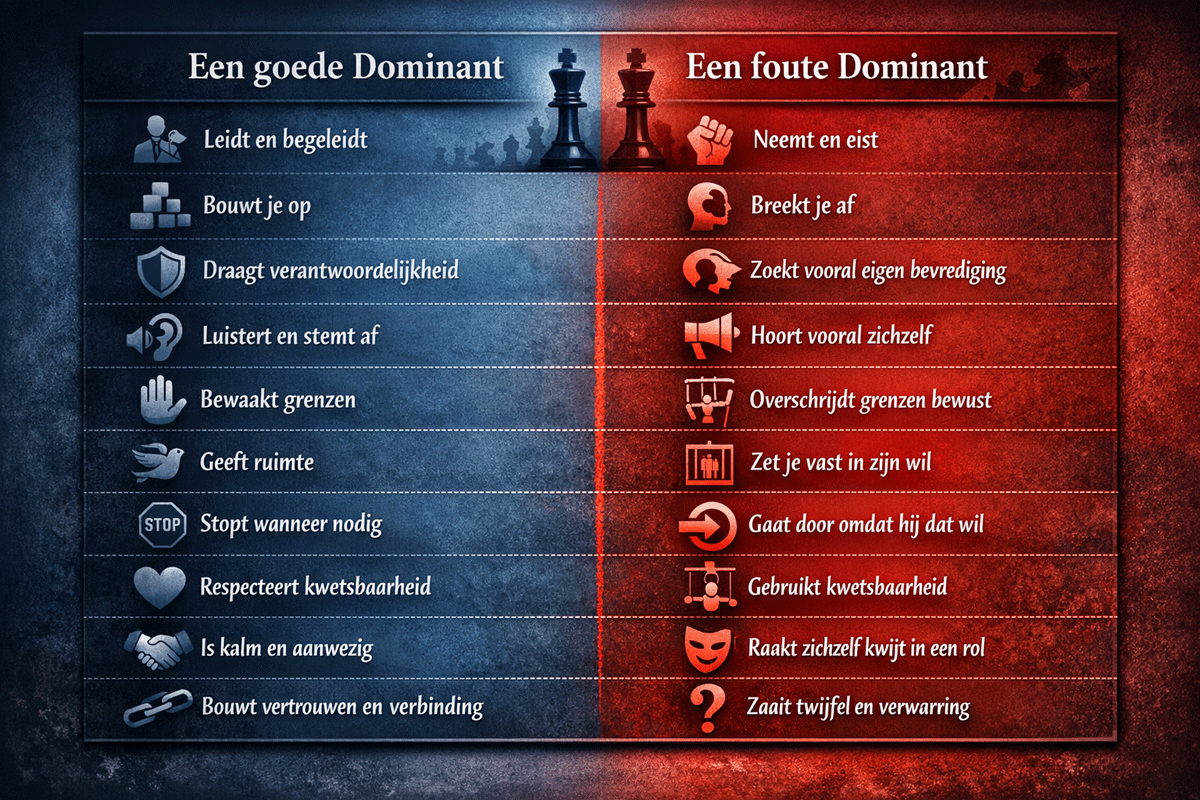
How bad Doms often show themselves
It rarely starts out crude. Often it is subtle. He talks a lot about what he wants to do, but hardly asks you any questions. Doubt or tension is brushed aside. Phrases like "you trust me, don't you?" are used to apply pressure. You get no time to feel where your limit lies, because according to him surrender simply has to hurt or be thrilling. Your feelings are made subordinate to his story.
When you say afterwards that something didn't feel right, it gets twisted. You'd be exaggerating, being too sensitive or not understanding your role. Your very longing for surrender is used to push you further, with nothing solid to fall back on. Often you only realise later that something wasn't right, once the adrenaline has dropped and the emptiness becomes noticeable.
An important signal is the absence of aftercare. After an intense session he disappears, mentally or literally. No check-in, no conversation, no attention to what it did to you. As if everything is done once his need has been fulfilled.
But also: bad subs exist
Crossing boundaries is not a one-way street. There are also subs who manipulate or use emotional dependency as a means of power. Phrases like "I can't live without you" or "you're the only one who can do this with me" sound intense, but can be meant to pin a Dom down. Agreements are made and broken, responsibility is shifted, and the Dom is expected to carry, feel and solve everything.
A sub who doesn't know their own limits or refuses to name them, yet expects complete care, puts the dynamic under pressure. Whatever the Dom does, it is never enough. Good BDSM requires maturity from both sides. Where honesty is missing, bad behaviour arises.
Signals you should take seriously
If someone ridicules your limits, structurally ignores your pace, belittles your feelings or makes doubt impossible, that is not a misunderstanding but a red flag. The same applies when aftercare is dismissed as nonsense or when jealousy and dependency are deliberately used to bind you. A healthy dynamic gives calm and stability. An unhealthy one leaves you insecure and empty.
Many people only feel after the fact that something wasn't right. That doesn't mean you are naïve. The moment itself can be overwhelming, and not everyone dares to trust their gut straight away. Don't be ashamed of that. Talk about it with someone you trust. Write it down if you have to, to get clear on what is chafing. Discuss it with the other person if that feels safe. And if that isn't possible, choose yourself. You owe nobody anything.
How do you reduce the chance of a wrong dynamic?
Take the time to get to know someone, not just in words but above all in behaviour. Pay attention to how someone reacts when you set a limit. See whether your pace is respected. Does the person feel calm and present, or rushed and pushy? And perhaps even more important: what is the contact like after a session?
Be honest with yourself too. Sometimes you want something to be right so badly that you explain the signals away. But your intuition is often clearer than your head. A good Dom will never push you. He or she creates space, not pressure.
Ultimately, it all comes down to reciprocity
A healthy BDSM dynamic is not a one-way street. The Dom leads and listens. The sub surrenders and guards their limits. Together you create a place where power and surrender meet without harm.
Perhaps that is the biggest red flag of all: the moment the word "together" disappears. When everything revolves around the will of one person, it is no longer BDSM. And then it is wise to pause and ask yourself what you are really doing here.
Want to read more about safe BDSM experiences? Also take a look at:
Frequently asked questions
What is the difference between a good and a bad Dom?
A good Dom leads from a sense of responsibility, listens and builds you up. A bad Dom takes without agreement, breaks you down and uses the dynamic mainly for his own gratification.
How do I know whether I can trust a Dom?
Take the time to get to know someone. Pay attention to how he reacts when you set limits, whether he asks questions and whether there is room for aftercare. A trustworthy Dom never pushes and always respects your pace.
What are the biggest red flags in a Dom?
Brushing off limits, belittling your feelings, wanting to play in a rush, considering aftercare unnecessary and pressuring you to surrender are clear signs that someone isn't playing safely.
Can subs also give off bad signals?
Yes. Some subs manipulate by creating dependency or guilt. They don't take responsibility for their own limits and so put unnecessary pressure on the Dom.
What should I do if I notice afterwards that something wasn't right?
Talk about it with someone you trust. Name what happened, also to the Dom if that still feels safe. And if that isn't possible, put your own recovery and safety first; you owe nobody anything.
Mistress Moriah
Source
Text: Mistress Moriah
Image: 123rf.com
Dit artikel is ook beschikbaar in het Nederlands →
Read also

Subs who are too young and BDSM: where do you draw the line
Subs who are too young and BDSM: where do you draw the line. On minors, age limits, responsibility and why ‘no’ is sometimes the most loving answer
13 January 2026
The importance of tears: letting go, healing and surrender
The importance of tears: letting go, healing and surrender. Yet tears are often seen as a sign of weakness. How often do we say to a child
22 May 2025
Without consent, it simply isn't BDSM
Without consent, it simply isn't BDSM. Consent. Permission. Agreement. Attunement. Whatever you call it, it is the lifeblood of every
11 July 2025