
What is the difference between a sub and a slave?
In this article
“What is the difference between a sub and a slave?” was written for BDSMforyou.nl by Mistress Moriah.
Within BDSM, people often talk about subs and slaves, but what exactly is the difference? The terms are often used interchangeably, even though they don’t mean the same thing to everyone. Anyone who delves into D/s dynamics will discover that the distinction isn’t just about behavior, but primarily about intensity, commitment, and lifestyle.
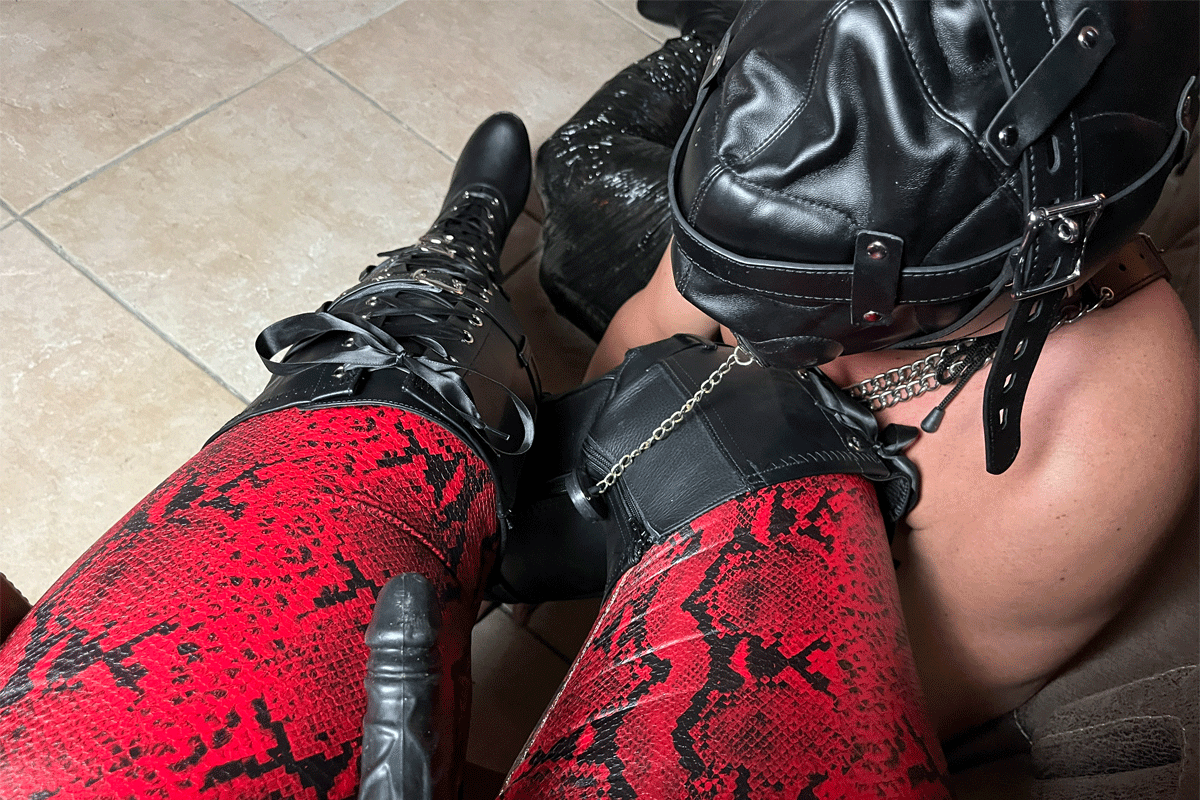
The Conventional Explanation
Most BDSM practitioners distinguish between a submissive (sub) and a slave.
A sub submits to the Dominant temporarily or within agreed-upon boundaries. This submission usually occurs during play or within a specific setting. Outside of that context, the sub is often on equal footing with his or her Dominant.
A slave, on the other hand, lives structurally in the service of the Dominant. The submission does not end after play, but is interwoven with daily life. A slave is submissive 24/7, in attitude, behavior, and experience. Incidentally, this does not mean that a slave crawls around on their knees 24/7.
In short: a sub plays with submission, a slave lives in submission.
To exaggerate a bit
To exaggerate the difference a bit: a sub can be a strong, independent personality in daily life - perhaps even someone accustomed to taking the lead. But in play, he or she enjoys letting go, following, and submitting. As soon as the play is over, that balance returns.
A slave, on the other hand, remains in a submissive attitude even outside of play. That doesn’t mean he or she has no opinion or life of their own, but the relationship with the Dominant always takes precedence. Submission is not a temporary role, but a way of life.
My personal experience
For me, the difference clearly lies in intensity and continuity. A slave is submissive 24/7; a sub primarily during play and/or during agreed-upon dynamics. Yet I myself often use the word slave for female submissives. That’s not because I always literally see them as slaves, but because the word has a softer, more affectionate ring to it for me. slave feels more intimate, more personal, and immediately makes it clear that we’re talking about a woman.
A slave can - for me - be at least as powerful or dominant outside of play as a male sub - but within the dynamic of submission, she takes on a certain softness, something that resonates more with the word slave for me.
What does the scene say?
Within the established BDSM community, the following rule of thumb usually applies: Yet the experience remains personal. Some couples deliberately use the terms interchangeably. Others avoid the word slave because it feels too loaded. In practice, each couple or household decides for themselves which terms suit their dynamic. In addition to sub and slave, there are many other terms that can be used within a D/s setting.
Submissive (sub): submits during scenes, within established boundaries and agreements.
Slave: lives in a state of surrender on a structural basis, often within a more formal or permanent D/s relationship.
Other terms for submissives
Within BDSM, there are several terms that each add a slightly different nuance to the role of the submissive party: Whether you’re talking about a sub, a slave, or a female slave: ultimately, it’s about the experience, not the labels. What is a lifestyle for one person is a game for another. As long as it’s based on mutual trust, consent, and connection, there is no single right or wrong term.
Bottom – the general term for the person who receives or undergoes. A bottom does not necessarily have to be a sub; it can simply refer to the person undergoing the physical acts, without mental submission.
Submissive (sub) – the submissive party within a D/s dynamic; the person who voluntarily submits to the Dominant.
Slave – the person who lives in a state of submission on a structural and long-term basis, sometimes within a formal 24/7 relationship.
Toy or object – a more playful or temporary use of power, in which the submissive acts as an “object,” but usually without a committed relationship.
Pet – a submissive in a playful or animal-like role (such as puppy or kitten), where care and affection are central.
Masochist – someone who derives pleasure from pain, but does not necessarily have to be submissive.
Above all, use the word that best suits you. Because at its core, BDSM isn’t about definitions, but about the intensity with which you live it.
Mistress Moriah
Source
Text & image: Mistress Moriah
Dit artikel is ook beschikbaar in het Nederlands →
Read also

What does the role of the dominant partner look like?
What does the role of the dominant partner look like? The dominant is the counterpart to the submissive. Other terms used include: top (English…
24 March 2026
Relationships & Roles - Theme Page
Relationships & Roles - Theme Page. In BDSM, it’s not just about acts or materials, but rather about the dynamics between people. Relationships and…
23 March 2026
In the mind of the sub or submissive (slave)
In the mind of the sub or submissive (slave). To connect with one another during a session or experience, it’s important to understand what’s going…
25 March 2026