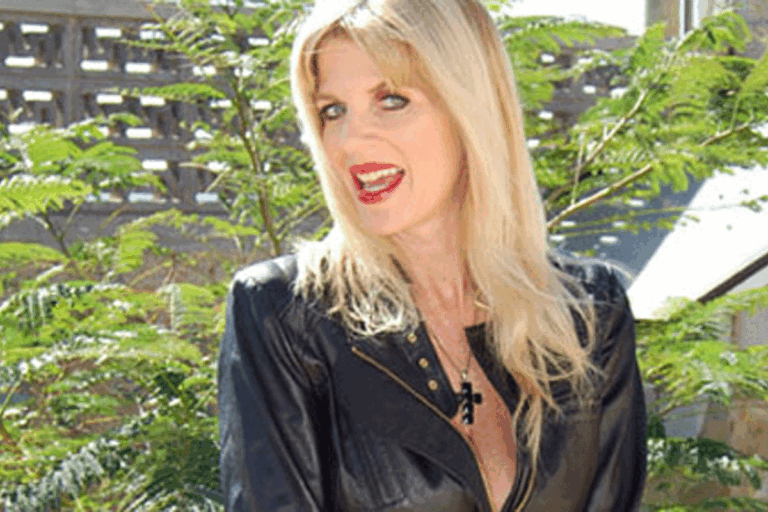
Interview with Jeanet Manders
In this article
- Easy to confide in
- Psychosocial counsellor
- Group conversations
- You say you are ‘kink-friendly’. What does that mean?
- What is the difference between BDSM, kink and fetish? Can a fetish go too far for you as well?
- Creative sex
- Lifeless object
- What does BDSM mean to you personally?
- Rope bondage
- Flirting both ways
- Still happy
- You organise special discussion groups for women. Can you tell us a bit more about that?
- Women's discussion groups
- Sharing experiences
- Will there be discussion groups for men too?
- What is the most common question people come to you with?
- Suitable relationship styles
- Is BDSM crazy?
- Do you have tips for people who are struggling with BDSM?
- Do you think there is enough (serious) information to be found on the internet?
- Can you explain why some people have difficulty accepting BDSM?
- Without labels
- How long does a session last and what does it cost?
- How can people contact you?
- What do you think of www.bdsmforyou.nl?
- Source
“Interview with Jeanet Manders“ was written for BDSMforyou.nl by Mistress Moriah.
After primary school I chose a creative profession, and after eight years at graphic design school I went to work in the graphic design and advertising industry. In my thirties I saw a psychologist for the first time, who helped me by asking the right questions; by answering them I got to know myself better. Through a friend I came to Re-evaluation Counselling, where you listen to each other with full attention and can allow your emotions and let your feelings discharge.
There I began to gain insight into what shapes a person and how the environment and society can influence (or have influenced) that, such as social and societal influences, patterns for women and men, background and your family. It was wonderful to see how much people differ and, at the same time, how much they have in common.
I became more and more interested in what motivates people, why they do what they do and how they deal with change. That is how I changed as a person, and my work changed too. I could relate less and less to advertising, with its mostly quick, superficial contacts, and I started thinking about a career change.

Easy to confide in
I wanted more personal contact and became more aware that others quickly feel at ease with me and readily confide in me, often discussing very confidential things. I also rely on my intuitive ability and a creative mind that keeps finding new ways to make difficult subjects open to discussion. I decided to look for a training course so I could use those qualities in a more focused way, and in 2008 I retrained at the Academie Integrale Menswetenschappen (SPSO) in Utrecht.
I felt and knew straight away that I had made the right choice! I had always known I wanted a creative profession, and there is nothing more creative than working with people. Everyone is different, so much has influenced (and continues to influence) how someone stands in life now, and everything is constantly changing; nothing is fixed. Heraclitus states that dealing with change is the task of every human being, because: “Everything flows, nothing stays. We cannot step into the same river twice… new water is constantly being supplied, and so the same river is not the same.”
Psychosocial counsellor
As a psychosocial counsellor I pay attention to the psyche and personality of my clients, and I also look at the influences from their environment. With a surprising approach, I want to help people come into their power by asking the right questions. I do this from an enthusiastic, open-minded and positive attitude.
By entering into an open conversation and asking questions out of genuine interest, I can help broaden their view. By not focusing only on the problems, but exploring how someone experiences them, what meaning they have in their life and how they deal with them, a more relaxed attitude emerges.
The attention is mainly focused on what your senses perceive and what you experience physically. That often gives a more fitting answer to life's questions than what you think of it or how you think about it.
Group conversations
I do this both individually and for couples, and in 2013 I started leading group conversations around a specific theme. There is a need for a safe place to simply say out loud all your thoughts, to share good but also bad experiences with each other, to help one another and perhaps even learn something from each other. As a psychosocial counsellor, that is not really a surprise to me. I focus on AD(H)D and recovering from burnout, personal growth and development, and more specifically on “dealing with narcissism” and “a different-than-usual sexuality” such as (BD)SM and other sex(es).
You say you are ‘kink-friendly’. What does that mean?
Because of the reticence that often still exists around speaking openly about sexuality, and the taboo on sexuality that differs from the norm, I chose to focus mainly on that. I am a qualified psychosocial counsellor who also has personal experience with BDSM, kink and fetishism. I don't find things strange easily, which makes me a trustworthy person to talk to, someone with whom more can be discussed about subjects that are not everyday for everyone. It often turns out to be a relief to be able to speak freely about this without running into possible incomprehension or, even worse, being confronted straight away with (pre)judgements and rejection.
What is the difference between BDSM, kink and fetish? Can a fetish go too far for you as well?
The English acronym BDSM stands for Bondage and Discipline (BD), Dominance and Submission (DS) and Sadism and Masochism (S&M, or SM).
Together these give an impression of the different elements that BDSM can include:
Bondage: tying up the partner; Discipline: real or role-played punishment; Dominance/Submission: exercising power or submitting to it; Sado/Masochism: causing or undergoing pain and/or humiliation.
Creative sex
In my view there is no clear distinction between BDSM and creative sex, or being kinky. It usually concerns sexual behaviours that deviate from what is considered normal. Because there is a taboo on BDSM, it is suddenly a more loaded subject to talk about than when you are kinky, or “naughtier and more mischievous than…”, but who decides that, and on what basis? What one person finds good, exciting sex is kinky to another and perverse to yet others. Some perversions may well belong to sexual behaviours that are very common among humans.
Oral pleasure is dismissed by some as perverse, while others say it simply belongs to sex. The line between normal and perverse behaviour is hard to draw. When certain sexual behaviours deviate even further from what is considered “normal”, people speak of ‘paraphilia’, which means ‘special preference’.
Lifeless object
In this context the term objectification is used to describe the degrading process in which a person is not seen as a person but as a lifeless object, or is used as an object of lust. This paraphilia is different from sexual fetishism, in which sexual pleasure or arousal is experienced through certain objects or rituals. In a broader sense it is a different way of experiencing sexual stimuli and feelings, with drives that make someone enjoy doing something that is “generally” considered deviant. The line between normal and perverse behaviour is hard to draw and is mainly a matter of taste and preference.
Personally, I struggle when a fetish is expressed unasked and thereby imposed on someone.
What does BDSM mean to you personally?
At the end of the ’90s I stepped into the wonderful world of the kinky/fetish/BDSM scene and felt like I was coming home. At last I had found a safe environment where I could be myself, where there was openness and togetherness and people respected each other and each other's differences. As for BDSM play, it is the intimate contact between people that attracts me so much. Being attuned to each other is essential. With pain play it is about well-built, measured pain: if it is too soft it is boring, and if it suddenly gets too hard it is over immediately, so you have to tune in to where the other person is and what they can (still) take.
With respect, you discover exciting new things together, seek out, explore and perhaps even push boundaries. For me it is also a way to keep growing personally. After all, you place yourself in a position or situation in which you would not otherwise find yourself, and in doing so you discover other parts of yourself.
Rope bondage
For example, I never thought I could enjoy rope bondage. Yet it is very special to experience what it is like to trust the other person, to dare to hand over the reins, to be unable to do anything but above all not to have to do anything. I felt secure and at the same time very vulnerable. Vulnerability that others have also shown me and that I can enjoy intensely, just as I find it very special when they place complete trust in me.
I knew from the start that I am a switch, meaning I can enjoy both sides equally, both the dominant, decisive role and the receptive, submissive role. A kind of easily touched switch, as it were, that flips depending on the person opposite me or the situation I find myself in. This all sounds very serious, whereas BDSM interaction is described as ‘play’. That is how I like to look at it: playful and creative, serious with a healthy dose of relativising humour.
Flirting both ways
So I flirt on both sides to get what I want and enjoy the exchange of energy, even if it is indirect via an object. Playing with different sensations that can range from softly stroking to hard blows. In a certain context and with the right intention, pain turns out to be a lovely way to calm my always busy ADHD head. Thinking doesn't work at moments when my body has intense sensations to process, just as during a sexual orgasm all thoughts vanish completely for a moment. That is what this different experience of sexuality offers me.
The regular clashes with more generally accepted norms and values, such as “thou shalt not hurt/hit another person”, make this a rather unusual path that at the same time feels so good. Partly because of this I have learned to express my desires and wishes more clearly, and I have also discovered what I don't like. Before play you discuss this and make clear agreements. Afterwards you discuss what went well and, where relevant, what didn't or what could perhaps be done differently. How many relationships lack this very important communication?
Still happy
I met my partner at the age of 16 and we are still together and happy. We had not yet heard of ‘kinky’ back then; that only came much later. So I know the ins and outs, in other words I know the challenge of bringing kink into your relationship, fitting it in and giving it shape. Especially in a long relationship where you have built up a lot together, experiencing sexuality differently from the norm is not easy to talk about and implement. After all, by voicing desires you could lose a lot, but there is certainly a lot to gain as well. Secrets and lies create distance; vulnerability builds a bridge you can walk across to come closer together.
You organise special discussion groups for women. Can you tell us a bit more about that?
Dialoog der (on)deugden (Dialogue of (Mis)Virtues) are gatherings in which we enter into dialogue, in a small group, about BDSM and fetishism and their impact on ourselves and on our relationships with others. It often begins with a proposition or question related to a topic chosen in advance. Anyone who wants to gets the chance to share experiences and thoughts about it.
This takes place in a safe environment. I bring my expertise as a qualified psychosocial counsellor with wide experience and knowledge in the field of BDSM, fetish and relationship (styles). There are few subjects that cannot be discussed.
Women's discussion groups
I have been organising the women's discussion groups for a number of years now in the Utrecht area and North Brabant. It is so much fun to do! I ensure a safe environment for all women, of all ages, with or without experience, regardless of their preferences and orientation, alone or in a relationship with a man or woman, perhaps with both or with several people, for dominant, submissive or switch, so both positions. Perhaps born a man and now going through life as a woman: every woman is warmly welcome.
Sharing experiences
I also often hear this in response: that it actually felt pleasant and safe straight away to dare to speak up, and that it is so nice to be able to share experiences, feelings and thoughts with others for once. Many do not dare to talk about this with others, while precisely because of the taboo it is so important to do so. Then possible misunderstandings can come to light, and psychological and/or physical harm can be limited or even prevented. It is wonderful to talk and reflect (on each other) in a safe environment with like-minded people, to share experiences and tips, a place where you can simply ask anything and (also) voice doubts. Talking is important!
Earlier this year I led a number of discussions for D/s couples in 24/7 (lifestyle/TPE). Here, other specific and often practical questions and topics come up. It turned out not to be easy every time to find the right words to describe their experiences, to name what something does or what it means to them. These conversations got many of those present thinking and reflecting. That is exactly the goal I have in mind.
Will there be discussion groups for men too?
In the future I would also like to organise groups for, for example, couples who are both Dominant or both submissive, newcomers, submissive men, etc. Always aimed at a specific target group so that there are enough similarities and points of contact. This gives the group cohesion, within which there is again enough room for everyone's own experiences and/or ideas. There is a need for this, and on top of that I also really enjoy doing it.
What is the most common question people come to you with?
Often there is a lot of doubt, fear and/or shame about talking about it. Is it crazy or strange that I want or enjoy “that”, and that I have those particular desires? If I give in to it, is there still a way back? Can I demand of myself or my partner that we deny this part? Will “it” perhaps go away by itself if we just don't talk about it? It seems easier to ignore those feelings and tuck them away than to explore them (together). Yet in practice I see that those feelings, often very deep desires, keep simmering. In fact they always come back up eventually, after a shorter or longer time, and usually more intensely than ever before.
Suitable relationship styles
How to start the conversation with their (play) partner and how to find suitable relationship (styles) are frequently asked questions. Finding a life partner is hard enough. If that person must also be the right play partner with matching (sexual) preferences, the pond to fish in becomes very small indeed. Partly because of this, relationships are more often (partly) opened up to contact with others. It is then important to think and talk about it carefully, because to what extent can and do you want to allow that, and what agreements do you make together about it?
As far as I am concerned, together means, preferably, with everyone involved, so also in consultation with possible (play) partner(s). Everyone has certain needs and desires, and is allowed to have wishes and voice them. It is up to the other person whether they want or are able to do something with them. Forcing someone to fit a predetermined picture will rarely go well. There must be enough room for everyone's own identity, personal growth and development.
Is BDSM crazy?
No, BDSM is not crazy... says the crazy one?
Do you have tips for people who are struggling with BDSM?
Look for information on the internet, read about it and find others who are interested in and involved with BDSM. There is not just one way, there are many; find what suits you and enjoy the journey of discovery. It is not the destination but the journey that is your goal.
Do you think there is enough (serious) information to be found on the internet?
There is enough to be found, although it is often about one particular (aspect of) play and is mostly aimed at the submissive (or receiving) side. Prescribed rules about what is and isn't done are not requirements, at most a guideline to see what suits you. Labels help to set frameworks, but it is the interpretation and experience that really matter.
Can you explain why some people have difficulty accepting BDSM?
Feeling safe and at ease with your sexuality and orientation, being able to be completely yourself and living in harmony is necessary for every person for self-preservation and a sense of well-being. By being different, including in the area of sexuality, you place yourself in the tension between force and counterforce. It brings uncertainties when you go against the social norm; this will provoke resistance and can unfortunately sometimes result in you being rejected or even excluded.
Every person needs intimate contact and wants to be able to share their experiences with others and talk about them. How open someone can, dares or wants to be therefore also depends on how much tension that person can bear. Tension and rejection often arise from a lack of understanding of different experiences of sexuality.
Without labels
It turns out to be easier to start a conversation if you manage to talk about the experience without labels (preconceptions). You understand each other better and see more similarities than differences. The differences seem smaller, and the similarities form a bridge to more understanding and respect for each other's differences. It is how the person experienced something that makes it so special. It is just the same when it comes to the experience of sexuality. Special experiences can no longer be shared because of the fear of rejection or (self-imposed) shame. How different it would be if we could be more open to diversity. After all, “you are you and not me”, but we are all unique.
How long does a session last and what does it cost?
I prefer to continue until a subject is finished and the conversation is rounded off, so that nothing remains unsaid because of time. Usually the first session lasts an hour and a half to two hours, after that usually about an hour, sometimes longer/shorter (charged per quarter as ¼ of the hourly price), which also depends on the agreement we make about this. We also decide together on the frequency and number of sessions, which we schedule straight away if possible. The costs are 60,- euros to 90,- euros per hour (depending on income), with a 10,- surcharge for couples.
How can people contact you?
Preferably via the contact form on my website: Jeanetmanders.nl. After receiving the completed intake form I will contact you to schedule an appointment. This can usually be done at fairly short notice (1-2 weeks).
What do you think of www.bdsmforyou.nl?
BDSMforyou offers a broad view of the wonderful world of BDSM. Carefully chosen words and thoughtfully written. Curious and open to all kinds of experiences. Solid information in which acquired knowledge and experience are shared. Experiences are shared objectively and with passion for those who are open to discovering BDSM. Highly recommended!
Mistress Moriah
Source
Text: Mrs Moriah
Image: Jeanet Manders
Dit artikel is ook beschikbaar in het Nederlands →